- breathing and freedom
Our
respiratory system is part of the involuntary nervous system and also
of the voluntary nervous system. Therefore by breathing consciously with
awareness we also affect our complete nervous system in a beneficial
way. If our awareness is on our breathing there is no place for anything
else and thus we experience relief from the hamster cage of our monkey
mind.  This is how Shunryu Suzuki speaks of it:
“If
you seek for freedom, you cannot find it. Absolute freedom itself is
necessary before you can acquire absolute freedom. That is our practice.
Our way is not always to go in one direction. Sometimes we go east;
sometimes we go west. To go one mile to the west means to go back one
mile to the east. Usually if you go one mile to the east it is the
opposite of going one mile to the west. But if it is possible to go one
mile to the east, that means it is possible to go one mile to the west.
This is freedom. Without this freedom you cannot be concentrated on what
you do. You may think you are concentrated on something, but before you
obtain this freedom, you will have some uneasiness in what you are
doing. Because you are bound by some idea of going east or west, your
activity is in dichotomy or duality. As long as you are caught by
duality you cannot attain absolute freedom, and you cannot concentrate.
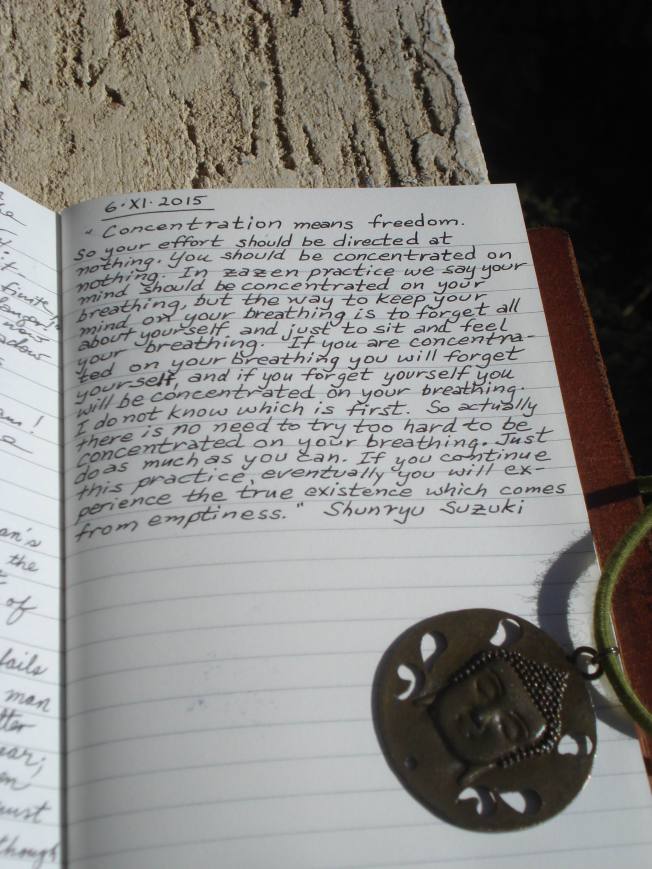
Concentration
is not to try hard to watch something. In zazen if you try to look at
one spot you will be tired in about five minutes. This is not
concentration. Concentration means freedom. So your effort should be
directed at nothing. You should be concentrated on nothing. In zazen
practice we say your mind should be concentrated on your breathing, but
the way to keep your mind on your breathing is to forget all about
yourself and just to sit and feel your breathing. If you are
concentrated on your breathing you will forget yourself, and if you
forget yourself you will be concentrated on your breathing. I do not
know which is first. So actually there is no need to try too hard to be
concentrated on your breathing. Just do as much as you can. If you
continue this practice, eventually you will experience the true
existence which comes from emptiness.”
Source: Shunryu Suzuki, Zen Mind, Beginners Mind, p. 112, 113
I
like how Shunryu gives us a taste of the playfulness of Zen that may
not often be sensed in most of the basic classic Zen texts. "Just do as
much as you can." This expresses the Zen attitude that each of us must
find our own true way. It cannot be found in any teaching of book.
Enjoy!
::
::
::
Anandamayi Ma – excerpt from the biography by Richard Lannoy
“Throughout
Indian history, this pattern of instruction ensured the transmission of
knowledge from one generation to the next. In the case of Anandamayi
who did not herself have a Guru, but was self-initiated, the traditional
model of the teacher and the taught has, in certain respects, taken on
new life, but in other equally important respects she radically departed
from tradition.
“Her role as a revered Brahmin divine
was by no means orthodox since this was a departure from the traditional
status parameters of the married woman; further, for some 50 years as a
widow and thus a member of the lowliest rank of Indian society, she was
at the same time one of the most sought after of all spiritual
teachers.
…
“In
the case of Anandamayi, it has become obvious, indeed widely known,
that we are dealing with a level of spiritual genius of very great rank;
her manifestation is extraordinarily rich and diverse.
“She
lived for 86 years, had an enormous following, founded 30 ashrams, and
travelled incessantly the length and breadth of the land. People of all
classes, castes, creeds and nationalities flocked to her; the great and
the good sought her counsel; the doctrine which she expounded came as
near to being completely universal as is attainable by a single
individual.
“Though she lived for the good of all, she
had no motive of self-sacrifice in the Christian sense: "there are no
others," she would say, "there is only the One". She came of extremely
humble rural origins, though from a family respected over generations
for its spiritual attainments.
“In the course of time she
would converse with the highest in the land, but draw no distinction
between the status of rich and poor, or the caste and sectarian
affiliations of all who visited her. She personified the warmth and the
wide toleration of the Indian spiritual sensibility at its freshest and
most accessible.
“The fact that she was a woman certainly
accentuates the distinctive features of her manifestation. Female sages
as distinct from saints capable of holding sustained discourse with the
learned are almost unheard of in India. Her femininity certainly
imparts to the heritage of Indian and global spirituality certain
qualities of flexibility and common sense, lyricism and humour not often
associated with its loftiest heights.
“Her quicksilver
temperament and abundant lila sacred play are in stark contrast with the
serenity of that peerless exemplar of Advaita Vedanta, Sri Ramana
Maharshi of Tiruvannamalai, the quintessence of austere stillness. That a
woman of such distinction and wide-ranging activity should emerge in
India in the 20th century, the century of world-wide feminism and reappraisal of feminine phenomenology hardly seems a coincidence
…
“I
believe Anandamayi has added a whole new spiritual dimension to the
re-awakening awareness of women to their own inheritance. As an
exemplary figure, she emanates a feeling of complete ease, warmth and
secure confidence in her femininity.
“Anne Bancroft, in
her line study of modern women mystics, Weavers of Wisdom, quotes this
moving statement by an English woman: "I felt she loved me so utterly
that I could never be the same again. Although I only saw her a few
times, I have never lost that feeling and her presence is always with
me. She was a person who had a vision of life and reality which she
could transmit in such a way that, since seeing her, I have always known
that there is harmony and purpose in the universe."
“In
the wisdom and profundity of Anandamayi's discourse we recognize the
true voice of the sage. But she was more than just a wise person,
although when it comes to defining exactly what this special extra
dimension to wisdom and spiritual goodness was, adequate words are hard
to find. She was, I believe, just about as near perfect a human
simulacrum of the divine as we are ever likely to encounter on this
planet. I chose the word 'simulacrum' with care for the simple reason
that I do not know what a divine human being really is. I am agnostic to
this degree, whereas the majority of her followers are devotees,
bhaktas, and for them she is, without qualification, truly a Divine
Being.”
Source: Richard Lannoy, Anandamayi, Her Life and Wisdom, p. 7, 8
::
Who Is Anandamayi Ma?
Anandamayi
Ma was a 20th-century avatar: a direct emanation of wisdom, born
totally awake. By her own testimony, Ma manifested in response to the
prayers of sentient beings for a female incarnation of the divine. While
accounts of her extraordinary lila, or enlightened activities,
are legion, she lived her life as a householder in unusually close
contact with her devotees, advising them about all aspects of life,
laughing with them, comforting them, singing and simply allowing all
those who came to find refuge in her presence. Her guiding presence is
still available to anyone who wishes to seek it out. Although Ma had
little formal education, she directly embodied enlightened wisdom to
such a degree, she was able to convey the subtlest teachings to tens of
thousands of followers from all walks of life. Her teachings are
precise, playful, gutsy, down-to-earth, inspiring and deeply
moving. Jaya Ma!
source
::
::
::

